


Chiropractic Adjustment Benefits and Risks: What to Know Before You Decide

Could a chiropractic adjustment help your specific pain, or leave you dealing with soreness or another concern? The chiropractic adjustment benefits and risks depend on your symptoms, health history, and the type of care being considered. It’s reasonable to want more than confident promises before deciding.
Adjustments may help some people with back pain, neck pain, or certain headaches, but results aren’t guaranteed, and adjustments aren’t right for every person or condition. Mild soreness or stiffness can happen afterward. Serious complications are considered very rare, but it’s still important to understand your personal risk and speak up about any concerns.
This guide explains what the evidence suggests adjustments may help, what side effects and warning signs to discuss, and how to weigh potential benefits against risks. You’ll also find practical questions to ask a qualified healthcare professional, so you can make an informed choice without pressure or promotional claims getting in the way.
Table of Contents
What chiropractic adjustments may help and what they do
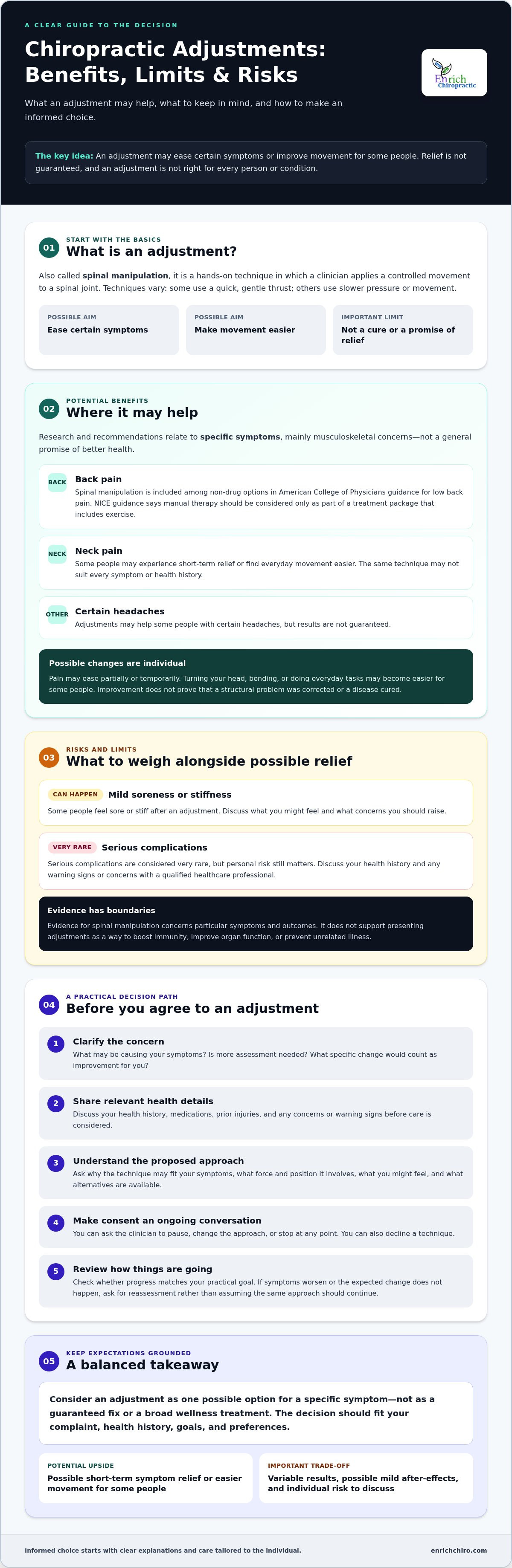
A chiropractic adjustment, also called spinal manipulation, is a hands-on technique in which a clinician applies a controlled movement to a spinal joint. The approach can vary. Some techniques use a quick, gentle thrust; others use slower pressure or movement. An adjustment is one form of care, not a synonym for all chiropractic care. For a neutral overview of the term, see this explanation of spinal adjustment.
A useful definition: An adjustment may help ease certain symptoms or improve movement for some people, but it can’t promise relief or cure an underlying disease.
What happens during a chiropractic adjustment?
The clinician should explain the proposed technique, why it may fit your symptoms, and what you might feel. Before agreeing, ask about the force, position, and alternatives. Consent is an ongoing conversation. You can ask the clinician to pause, change the approach, or stop at any point. You can also decline a technique.
Chiropractic adjustment benefits and risks should be considered in light of your specific concern, not broad claims about general health.
Which symptoms may improve, and how much?
Evidence and clinical recommendations vary by condition. For low back pain, American College of Physicians guidance includes spinal manipulation among non-drug options. NICE guidance for low back pain and sciatica says manual therapy should be considered only as part of a treatment package that includes exercise. These recommendations support considering it as an option, not treating it as the best choice for everyone.
Some people with back or neck pain may experience short-term relief or find daily movement easier. The amount of change varies with the diagnosis, how long symptoms have lasted, the technique used, and the person. A change in pain or function doesn’t mean an adjustment has corrected a structural problem or cured a disease.
Relief: Pain may ease, but improvement can be partial or temporary.
Function: Turning your head, bending, or completing everyday tasks may become easier for some people.
Individual fit: The same technique may not suit every symptom or health history.
A clinician should connect the suggested approach to your complaint and explain what improvement would look like. That makes it easier to weigh a possible benefit against the limits of the evidence and decide whether to proceed.
How evidence and individual factors shape adjustment benefits
Evidence for spinal manipulation relates to specific symptoms, not a general promise of better health. Research has examined it mainly for musculoskeletal concerns such as back and neck pain. The National Center for Complementary and Integrative Health (NCCIH) summarizes research on chiropractic care, including its use for pain. That evidence does not support treating adjustments as a way to boost immunity, improve organ function, or prevent unrelated illness.
Judge adjustment evidence by the condition being treated, the outcome measured, and the person receiving care. A result for one kind of back pain can’t automatically be applied to a different diagnosis or a broad wellness claim. That distinction matters when weighing chiropractic adjustment benefits and risks.
Why outcomes differ from person to person
Two people with neck discomfort may have different causes, health histories, symptom duration, and goals. One may hope to turn their head more comfortably; another may need an assessment to understand persistent or changing symptoms. Those differences can shape whether an adjustment is appropriate and what a realistic result might be.
Symptoms can also change over time for reasons beyond a particular treatment. Feeling better after an adjustment doesn’t prove the adjustment caused every improvement. Agree on a practical goal, such as easier movement or less interference with daily activities, and check whether progress matches it. If symptoms worsen or the expected change doesn’t happen, ask for a reassessment rather than assuming the same approach should continue.
What an adjustment can and cannot be expected to do
A reasonable expectation is a possible change in symptoms or function, not guaranteed structural correction. An adjustment shouldn’t be presented as putting every joint “back in place,” curing disease, or preventing unrelated health problems. Ask the clinician to explain what evidence applies to your specific complaint and what uncertainty remains.
Consider discussing these factors before deciding:
Diagnosis: What may be causing the symptoms, and is further assessment needed?
Personal goal: What change would matter in daily life, and how will you review it?
Preferences and health: What approach feels acceptable given your history and comfort?
Other options: What evidence-based alternatives fit the same concern?
A qualified healthcare professional can help compare options in light of your symptoms and health history. If you’re considering an adjustment in Kennesaw, a one-on-one conversation about your care goals can help you raise questions and understand whether the approach may suit your situation. An honest discussion should leave room for alternatives and for deciding not to proceed.
Chiropractic adjustment risks: common effects and serious concerns
Most reported side effects after spinal manipulation are temporary, but they still matter when weighing care. The National Center for Complementary and Integrative Health lists effects such as soreness, stiffness, or headache. Research has also reported rare serious complications. Their frequency is difficult to establish, so claims that a specific risk is impossible or precisely predictable aren’t warranted.
Common short-term effects after an adjustment
You may notice mild soreness, stiffness, or a headache after an adjustment. These effects often settle, but there’s no single timeline that applies to everyone. Tell the clinician if a reaction feels severe, persists, worsens, or concerns you. Don’t assume a new or unusual symptom is simply part of the process.
Before treatment, ask what side effects are expected with the specific technique being proposed and what to do if they occur. Your comfort matters. You can ask to pause or stop, and you don’t have to continue with an approach that doesn’t feel right.
When neck manipulation deserves extra caution
Neck manipulation has been linked in reports and studies to cervical artery dissection, a tear in the lining of an artery in the neck. The association is rare, and available evidence hasn’t established that manipulation causes these events. A dissection can itself begin with neck pain or headache, which may lead someone to seek care. This makes the relationship difficult to interpret, and the uncertainty shouldn’t be dismissed.
Discuss your health history and alternatives before any neck technique, especially if you have had unusual neck pain, a severe headache, or a blood-vessel problem. Ask the clinician to explain the proposed method and its risks. You can decline neck manipulation and discuss other options.
Get urgent medical help for sudden severe headache, unusual or intense neck pain, weakness, trouble speaking, or vision changes, particularly if these symptoms appear suddenly. Don’t wait for a routine appointment or assume they’re a normal reaction to treatment.
Considering chiropractic adjustment benefits and risks means paying attention to both common temporary effects and rare, serious concerns. Clear answers about your personal history, the technique, and other care options can help you make a decision without pressure.
How to decide whether an adjustment is appropriate for you
A clear decision starts with your symptoms, not a preset technique or schedule. Clarify what hurts, when it began, what makes it better or worse, and how it affects daily activities. Then review your health history, discuss options, and agree on a practical goal before deciding whether to proceed. This gives you a useful basis for weighing chiropractic adjustment benefits and risks in your own situation.
Questions to ask before agreeing to treatment
You deserve clear answers before care begins. Ask the clinician:
What do you think may be causing my symptoms, and what supports that assessment?
What change might an adjustment help with, and what remains uncertain?
What side effects or harms should I consider?
What alternatives are appropriate, including options that don’t involve an adjustment?
What technique do you recommend, and can I pause or withdraw consent at any time?
Consent should be specific to the approach being discussed. You can ask for more explanation, request a change, or decline. A responsible conversation should leave room for questions and alternatives.
Health factors and symptoms to raise first
Share relevant diagnoses, medications, pregnancy, osteoporosis, prior spinal injuries, and previous treatments. Include changes in your symptoms, even if they seem unrelated. These details don’t automatically rule an adjustment in or out. A qualified clinician should consider your individual circumstances and explain whether another evaluation or approach may be safer or more suitable.
Some symptoms call for medical attention before an adjustment is considered. Seek prompt evaluation for new weakness or numbness, fever with pain, or symptoms after major trauma. Loss of bladder or bowel control, especially with new weakness or numbness, requires emergency medical care. Severe, worsening, or unexplained symptoms also deserve timely assessment rather than a routine adjustment appointment.
Before leaving a consultation, make sure you understand the proposed next step and how you’ll judge whether it’s helping. A useful goal might be a specific daily task becoming easier, rather than a promise that pain will disappear. If the plan doesn’t match your preferences or concerns, it’s reasonable to pause and seek another qualified opinion.
If you’re considering care in Kennesaw, request a first-visit consultation and adjustment to discuss your symptoms, health history, and questions with Enrich Chiropractic. An adjustment may not be appropriate for everyone, and a conversation should help you decide without pressure.
Choosing personal, low-pressure chiropractic care in Kennesaw
Choosing a provider is part of making an informed decision about chiropractic adjustment benefits and risks. Look for someone who explains their reasoning in plain language, listens to your concerns, and asks about your health history before recommending an approach. You should be able to discuss alternatives, understand what you’re agreeing to, and decline a technique without pressure.
Enrich Chiropractic offers one-on-one adjustment discussions in Kennesaw with Dr. Rich. The practice describes its adjustments as gentle and provides individual-visit care rather than memberships or long-term treatment plans. That may suit people who want to discuss a specific concern without committing to an ongoing plan. It doesn’t mean an adjustment is right for every person or condition.
What a straightforward first conversation should include
A first conversation should make room for your symptoms, health history, goals, and questions. Before consenting, make sure you understand the proposed approach, what it may help with, and any concerns or alternatives relevant to you. You can read more about first-visit chiropractic care and pricing details before deciding what to ask.
Good signs include clear answers, a willingness to tailor the discussion to your needs, and respect for your choice. Be cautious of promises of guaranteed results or pressure to agree before your concerns have been addressed.
Matching care discussions to your symptoms
Describe your symptoms as specifically as you can. For example, mention whether neck stiffness affects turning your head, or whether leg discomfort travels from your back. Enrich Chiropractic has additional information about chiropractic care for a stiff neck and understanding sciatica and relief options. These pages can help you prepare, but they don’t replace an individual assessment.
Use the conversation to confirm whether the suggested care fits your symptoms and preferences. Ask about the technique, possible benefits and effects, and other appropriate options. Enrich Chiropractic accepts walk-ins and same-day appointments, including on Sundays. Check directly with the practice for current appointment availability.
For people in Kennesaw, Acworth, Woodstock, and Marietta, a one-on-one discussion can be a practical way to raise questions before deciding. If that would help you consider your options, discuss your concerns with Enrich Chiropractic. The goal is a clear, personal conversation, not a promise that an adjustment will solve every problem.
Make your next care decision with confidence
The key to weighing chiropractic adjustment benefits and risks is to focus on your specific symptoms, health history, and goals. An adjustment may help some people with pain or movement, but results aren’t guaranteed, and the evidence doesn’t support broad claims that it treats unrelated conditions. Ask about the proposed technique, possible effects, and alternatives before you decide. You can pause or decline if you’re not comfortable.
If you’re considering care in Kennesaw, Enrich Chiropractic offers one-on-one visits with Dr. Rich. The practice provides individual-visit care without memberships or long-term treatment plans. An adjustment may not be right for everyone, so start with an open conversation about your concerns.
Discuss your symptoms and questions with Enrich Chiropractic. You deserve clear information and the space to choose the next step that feels right for you.
Frequently Asked Questions
Can chiropractic adjustments help back or neck pain?
They may help some people with certain types of back or neck pain, but results vary. The likely benefit depends on what’s causing the pain, your health history, and the technique used. An adjustment isn’t a guaranteed cure. Ask a qualified clinician what evidence applies to your symptoms and what alternatives are reasonable. These are central points to weigh when considering chiropractic adjustment benefits and risks.
Are chiropractic adjustments safe?
Many people report no serious problems or only temporary effects such as soreness, stiffness, or headache. Serious complications have also been reported, though rarely, and individual risk can depend on health history and the technique. Discuss your concerns before treatment, especially before neck manipulation. Seek urgent medical care for sudden severe headache, weakness, speech difficulty, or vision changes. A clinician should help assess your personal circumstances.
Can a chiropractic adjustment cause a stroke?
Stroke and cervical artery dissection have been reported in connection with neck manipulation, but the relationship is complex, and an association doesn’t prove the technique caused the event. In some cases, symptoms may begin before someone seeks care. Discuss neck techniques and alternatives with a qualified clinician before proceeding. Sudden weakness, difficulty speaking, vision changes, or a severe, unusual headache requires emergency medical attention.
How long does soreness last after a chiropractic adjustment?
Mild soreness, stiffness, or headache after an adjustment is generally described as temporary, but the duration varies. There’s no fixed timeline that applies to everyone. Contact a healthcare professional if symptoms are severe, worsening, persistent, or unusual. Sudden weakness, speech difficulty, vision changes, or a severe headache needs urgent evaluation rather than routine follow-up. Tell your clinician what you’re experiencing and when it started.
Who should avoid chiropractic adjustments?
There isn’t one rule that applies to every person or technique. Health conditions, medications, recent injuries, and specific symptoms can change whether an adjustment is suitable or needs further assessment. Share your complete health history with a qualified clinician, including prior spinal injuries and current concerns. Ask whether an adjustment, a modified approach, or another type of care makes sense for your situation.
What should I ask before getting a chiropractic adjustment?
Ask what may be causing your symptoms, what benefit is realistic, and what supports the recommendation. Discuss possible side effects, serious risks, alternatives, and how progress will be reviewed. Confirm which technique is proposed and whether another approach is available. You can ask questions, pause, or decline at any point. If you have emergency warning signs, seek urgent medical evaluation instead of routine care.
Do I need repeated chiropractic adjustments to get results?
Not necessarily. Visit frequency should depend on your symptoms, response, preferences, and the clinician’s assessment. No universal schedule guarantees a result. Ask how progress will be measured and when care should be reviewed or changed. Enrich Chiropractic provides individual-visit care without memberships or long-term treatment plans. The Kennesaw practice serves people from nearby Acworth, Woodstock, and Marietta as well, but an adjustment may not suit every person.



Comments