


Upper Back Pain Specialist in Acworth for Disc Conditions

A disc diagnosis doesn’t automatically mean surgery. An upper back pain specialist in Acworth can assess your symptoms and discuss whether chiropractic care may be appropriate as part of an individualized approach. With a herniated disc or spinal stenosis, next steps depend on symptoms, nerve involvement, and spinal stability.
Upper back pain can feel especially restrictive because this part of the spine moves less freely than the neck or lower back. It’s understandable to want clear guidance on what might help and where to start. This article explains which upper back concerns chiropractic care may address, how disc conditions fit into the picture, and what to expect when arranging an appointment in Acworth. You’ll also find practical accessibility information to help you plan your visit.
Table of Contents
Conditions treated, including herniated discs and spinal stenosis
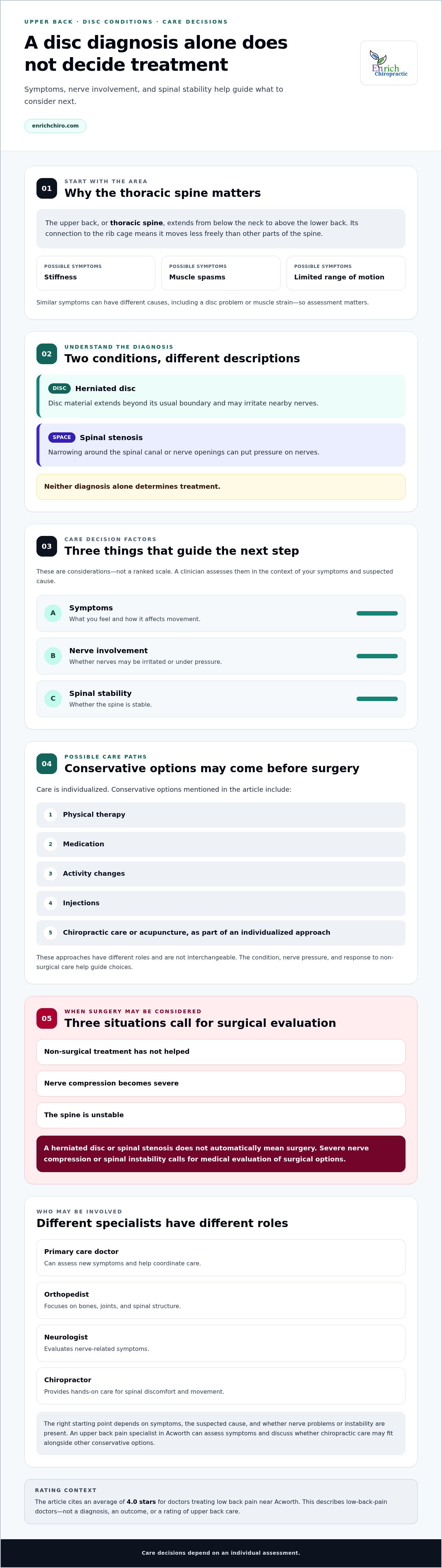
The upper back, or thoracic spine, extends from below the neck to above the lower back. Because it connects to the rib cage, it moves less freely than other parts of the spine. Pain may come with stiffness, muscle spasms, or limited range of motion. Similar symptoms can have different causes, including a disc problem or muscle strain, so assessment matters.
A herniated disc occurs when disc material extends beyond its usual boundary and may irritate nearby nerves. Spinal stenosis is narrowing around the spinal canal or nerve openings, which can also put pressure on nerves. Neither diagnosis alone determines treatment. Symptoms, nerve involvement, and spinal stability all inform the next step.
A primary care doctor can assess new symptoms and help coordinate care. An orthopedist focuses on bones, joints, and spinal structure; a neurologist evaluates nerve-related symptoms; and a chiropractor provides hands-on care for spinal discomfort and movement. The right starting point depends on your symptoms, the suspected cause, and whether nerve problems or instability are present.
People searching for doctors treating low back pain near Acworth, Georgia, may see an average rating of 4.0 stars for those doctors. That figure describes doctors treating low back pain, not a diagnosis, outcome, or rating of upper back care. Use it as limited context, then focus on whether a clinician evaluates the relevant spinal area and explains the care options in plain language.
Orthopedic specialists assess conditions involving the spine, bones, joints, and related structures. Their evaluation can help distinguish a disc condition from other sources of pain. Care may include conservative options before surgery is considered, such as physical therapy, medication, activity changes, or injections. Chiropractic care, physical therapy, and acupuncture have different roles and may be considered within an individualized approach.
Pain management can help address symptoms while the cause and appropriate care are assessed. Medication and injections are among the conservative options used for spine problems. Acupuncture may also be considered as part of a broader plan. These approaches are not interchangeable: the condition, nerve pressure, and response to non-surgical care guide the choices.
Surgery is generally considered when non-surgical treatment has not helped, nerve compression becomes severe, or the spine is unstable. A herniated disc or spinal stenosis does not automatically require surgery. An upper back pain specialist in Acworth can assess your symptoms and discuss whether chiropractic care may fit alongside other conservative options. Severe nerve compression or spinal instability calls for medical evaluation of surgical options.
Accessibility and appointment information
When choosing an upper back pain specialist in Acworth, consider whether the provider’s role fits your symptoms and whether care options are explained clearly. Patient feedback can offer context, but ratings alone cannot establish which type of care is appropriate. Look for clear information about appointment arrangements and what happens at the first visit.
Before your visit, note when the pain began, which movements affect it, and whether it followed an injury or sports activity. Bring relevant medical records and a list of medicines. These details give the practitioner useful context and make it easier to explain your concerns.
A first visit typically starts with a discussion of your symptoms and health history, followed by an examination suited to your concern. Describe any changes in movement or symptoms that travel into your arms. If you’re considering an upper back pain specialist in Acworth, use the first appointment to understand the assessment and ask how the proposed care relates to your symptoms.
Appointment access depends on the office schedule. Enrich Chiropractic accepts walk-ins and same-day appointments, including Sundays. If your plans change, contact the office to discuss rescheduling. Share any access needs when arranging your visit so you can plan your arrival comfortably.
Prepare a few questions before your appointment: What does the first visit include? What records should I bring? How are follow-up visits arranged? Clear answers help you understand the process. At Enrich Chiropractic, the first visit includes a consultation and adjustment, with time to discuss back discomfort and the approach to care.
If you’re ready to plan a visit, the appointment and chiropractic care information can help you take the next step.
For arrival planning, the Acworth office is on the 2nd floor inside the Governor's Pavilion. Keep that location detail with your appointment information so it is easy to check before setting out. If you have questions about finding the office or coordinating your visit, contact the office before you travel rather than relying on assumptions about access or arrival arrangements. You can also mention any mobility, communication, or scheduling needs when you call, giving the office an opportunity to discuss what can be arranged. Allow yourself time to review the directions and gather the records and questions you want to bring, while remembering that the office can confirm visit-specific details.
For Dr. Daftari, the Acworth office phone number is (770) 758-5573. Calling can be a practical way to confirm appointment availability, discuss rescheduling, or ask what to expect when you arrive. If you are unsure whether a particular access need can be accommodated, explain it clearly and ask the office directly; do not assume that a feature or arrangement is available unless it has been confirmed. Before ending the call, make a note of any instructions you receive and any details you still need to clarify. Having the office location and phone number together can make it easier to plan your visit and seek help if your arrangements change. This preparation can help keep the focus on discussing your upper back symptoms and understanding the next steps in care.
Acute and chronic upper back pain
Acute pain begins recently, while chronic pain persists or keeps returning. Either pattern can affect the thoracic spine, the section below the neck and above the lower back. Possible causes include muscle strain, injury, and spinal conditions such as a herniated disc. Carrying heavy bags for a long time, for example, may leave the upper back stiff or sore. Limited movement and muscle spasms can also accompany upper back pain.
The rib cage limits movement in the thoracic spine compared with other spinal areas. As a result, discomfort may be noticeable when twisting, reaching, or taking a deep breath. Note which movements bring on pain, where you feel it, and whether it spreads. These details give a clearer picture than a general description such as “my back hurts.”
What are common causes of upper back pain? Muscle strain, injuries, and spinal conditions, including disc problems, are possible causes. Symptoms alone do not identify the source, so note where the pain is, how movement is affected, and whether there are related nerve symptoms.
When should upper back pain require urgent medical care? Seek urgent care for sudden, severe pain or pain accompanied by symptoms that make you feel acutely unwell. If pain continues for more than a few weeks, arrange a consultation with a spine specialist.
For persistent discomfort, note whether symptoms are worsening, recurring, or limiting everyday tasks such as dressing or reaching overhead. A simple symptom record can help track changes between visits. Include when the pain began, activities that aggravate it, and any injury or sports activity that came before it. Do not assume persistent pain has the same cause as an earlier episode.
Care may involve more than one type of professional. A doctor can assess symptoms and guide next steps, while physical therapy or rehabilitation may be considered as part of conservative care. A provider’s degree, relevant training, and experience with spinal conditions help clarify their role. Fellowship training may reflect further study in a specialty, but it does not replace an assessment of your symptoms.
For a recent strain, note which movement triggers discomfort and adjust activities that worsen it.
For recurring pain, track flare-ups and how they affect work, sleep, or daily movement.
For pain that lasts more than a few weeks, arrange a spine specialist consultation.
A hospital or specialist setting may be appropriate when symptoms need further medical assessment. Spine surgery is generally considered when non-surgical treatment has not helped, nerve compression becomes severe, or the spine is unstable. The decision depends on the diagnosis and clinical findings, not simply on whether pain is acute or chronic. A clear symptom timeline can help the treating team discuss next steps.
Chiropractic care in Acworth
Chiropractic care may be one part of an individualized approach to upper back pain. The thoracic spine lies between the neck and lower back, and the rib cage limits its movement. Before considering an adjustment, a chiropractor can discuss your symptoms, daily activities, and movement. This helps relate care to your specific concerns rather than treating every sore back the same way.
Pain after hours at a desk may feel different from discomfort after lifting or sports activity. Tell the practitioner where it hurts, what movements aggravate it, and whether the pain travels elsewhere. Mention any known disc diagnosis or degenerative changes. These details help guide a conversation about whether chiropractic care fits your situation or another type of assessment is appropriate.
A chiropractic adjustment is a hands-on procedure considered in light of your symptoms and the practitioner’s examination. It is not surgery, and chiropractic care does not replace surgical assessment when nerve compression is severe or the spine is unstable. Minimally invasive surgery is a separate medical treatment, not a chiropractic procedure.
To make your appointment useful, prepare a short list before you arrive:
Describe when the upper back pain began and what worsens it.
Note any past injuries, disc diagnosis, or relevant medical care.
Explain which everyday movements, such as reaching or turning, feel limited.
Ask what the proposed care involves and how progress will be discussed.
Training matters, but a title alone does not tell you how a practitioner will approach your symptoms. A chiropractic degree reflects professional education, while the name of a university or school does not explain the proposed care. Look for a clear explanation of the assessment and procedures. Understand what an adjustment involves before deciding whether to proceed.
Chiropractic care may sit alongside other conservative options, including physical therapy and acupuncture, in an individualized approach to upper back pain. These options have different roles. Movement-focused therapy may address activity limits, while an adjustment is a hands-on chiropractic procedure. The discussion should reflect your condition and goals, especially if a disc problem or degenerative spinal change is involved.
In Acworth, a chiropractor may be a practical point of contact for back discomfort when you want to discuss whether an adjustment is suitable. Bring relevant records and describe your symptoms clearly. If an assessment points to severe nerve pressure or spinal instability, medical evaluation of other treatment options takes priority. The aim is a sensible next step, not a promise that one procedure will address every cause of upper back pain.
What type of specialist treats upper back pain in Acworth, GA?
The right specialist depends on the possible cause of your pain and any accompanying symptoms. In Acworth, Georgia, a primary care doctor can assess your concern and help guide next steps. Orthopedists, neurologists, chiropractors, and spine surgeons have different roles. Start with your symptoms, not a title alone.
A primary care doctor can be a practical first contact for new or recurring discomfort. Describe where the pain is, what makes it worse, and whether it affects movement. Pain that began after lifting, for example, differs from pain accompanied by tingling or weakness. This history helps the doctor decide whether further evaluation or a referral is appropriate.
An orthopedist focuses on bones, joints, and other structures involved in movement, including the spine. This may be relevant when pain could involve a spinal condition or injury. A neurologist focuses on the nervous system and may be appropriate when symptoms include nerve-related changes. Mention pain that travels into an arm or changes in sensation or strength.
A chiropractor provides chiropractic care, which may be considered as part of an individualized approach to upper back pain. Discuss your symptoms and health history before an adjustment. A chiropractor is not a substitute for evaluation of severe nerve compression or spinal instability. Those situations may require medical assessment of other treatment options.
A spine surgeon evaluates whether surgery may be appropriate for a spinal condition. Surgery is generally considered when non-surgical treatment has not helped, nerve compression becomes severe, or the spine is unstable. Conservative care may include physical therapy, medication, activity changes, and injections. A surgical consultation does not mean surgery is automatically the next step.
Use this simple decision guide when choosing where to begin in Acworth:
Choose primary care for an initial assessment of pain without a known cause.
Consider an orthopedist for concerns involving spinal structure, joints, or injury.
Consider a neurologist when nerve-related symptoms are part of the problem.
Discuss chiropractic care when hands-on care is of interest and symptoms suit that approach.
Seek a spine surgeon’s evaluation when severe nerve compression or instability is being considered.
When looking for an upper back pain specialist in Acworth, consider whether the professional’s role matches your symptoms. Bring a brief symptom timeline and relevant records. Ask for a plain explanation of the assessment and proposed next steps. Clear answers help you understand how care may address your concern.
For back discomfort where chiropractic care is a suitable next step, you can book a first-visit consultation and adjustment. Severe nerve compression or spinal instability requires medical evaluation rather than relying on an adjustment alone.
Enrich Chiropractic: First visit consultation and adjustment
Enrich Chiropractic offers a first visit consultation and adjustment for people seeking chiropractic care for back discomfort. Describe where your upper back hurts, which movements affect it, and whether symptoms are changing. Sharing a known disc diagnosis and relevant medical history gives the discussion useful context.
A standard chiropractic adjustment may be considered based on your concerns and assessment. Ask what it involves and discuss any questions before proceeding. Severe nerve compression or spinal instability calls for medical evaluation rather than relying on chiropractic care alone.
To discuss whether a chiropractic visit fits your needs, book an appointment with Enrich Chiropractic or visit enrichchiro.com.
Take the Next Step Toward a Clear Care Plan
Your next step can be simple: decide what you want help understanding and bring that concern to your appointment. You may want to discuss which movements trigger discomfort, how symptoms affect daily activities, or whether hands-on care is appropriate. Choosing an upper back pain specialist in Acworth starts with finding a visit where you can raise these questions and understand the proposed approach.
Enrich Chiropractic offers a first visit consultation and adjustment, standard chiropractic adjustments, and back pain care. These services provide a starting point for discussing upper back discomfort and whether chiropractic care fits your needs. Describe your symptoms and concerns directly to keep the conversation focused on your situation.
Contact Enrich Chiropractic to discuss care and take the next step at your own pace. A thoughtful conversation can help you move forward with more clarity.
Frequently Asked Questions
Do Acworth chiropractors treat upper back pain, and what conditions do they treat?
Yes. Chiropractors provide care for upper back discomfort and related movement limitations. Enrich Chiropractic offers back pain care and chiropractic adjustments. Describe whether reaching overhead or turning your torso increases discomfort. A disc diagnosis may need broader medical assessment, especially if symptoms involve severe nerve compression or spinal instability. Chiropractic care does not replace that evaluation.
Do Acworth upper back pain specialists accept my insurance or require referrals?
Insurance coverage and referral rules depend on your health plan and the type of specialist you choose. Review your plan’s chiropractic benefits and referral terms before booking. A plan may treat chiropractic visits differently from appointments with an orthopedist or neurologist. If you are comparing upper back pain specialists in Acworth, review the relevant plan details so you understand your coverage and any referral requirements.
What tests and treatments are commonly used for upper back pain?
Assessment commonly begins with a discussion of your symptoms and a physical examination of movement and tenderness. Further tests depend on the findings and suspected cause. Care may include activity changes, medication, physical therapy, injections, or chiropractic care; acupuncture may also be considered as part of an individualized approach. Surgery is generally considered when non-surgical care has not helped, nerve compression is severe, or the spine is unstable.



Comments